A new recognition of the SQEL cutting-edge research has been given by Raith Nanofabrication to our researcher Nadia Ligato who won the third prize of theRAITH Micrograph Award 2019!
The micrograph winning the award pictures a superconducting quantum interference proximity transistor (SQUIPT), a multi-tunnel junctions device fabricated using electron beam lithography technique and shadow-angle evaporation.
Many compliments to Nadia and stay tuned to not miss new updates about her work!
The Nanowire Week is one of the biggest conferences on nanowires merging two well-established and highly successful annual workshops: NANOWIRES and the Nanowire Growth Workshop. The 2019 edition has been held in Pisa from September 23 to 27 organized by NEST, Scuola Normale Superiore and CNR Istituto Nanoscienze.
Our researcher Elia Strambini presented some unpublished results of our group in a a talk titled “Magnetically-driven anomalous phase shift in InAs nanowire Josephson Junctions” about the revealing of an anomalous phase shift in a Al/InAs(NW)/Al Josephson junction.
A new research carried out at the SQEL report the realization of a titanium-based monolithic superconducting quantum interference device (SQUID) which can be tuned by applying a gate bias to its two Josephson junctions.
The research, published on Nano Letters by F. Paolucci and co-authors, points out the strong implications of the apparent coupling of a static electric field to the macroscopic phase of the superconducting condensate.
Beyond that, this class of quantum interferometers could represent a breakthrough for several applications such as digital electronics, quantum computing, sensitive magnetometry, and single-photon detection.
The project T-CONVERSE “Temperature-to-phase CONVErsion THz Radiation SEnsors”, a collaboration between INFN Sezione di Pisa (F. Paolucci), CNR-Nano (F. Giazotto) and SeeQC-Eu (O. Mukhanov), is one of the projects recommended for funding in the call ATTRACT for the development of breakthrough sensing and imaging technology.
Advances in nanofabrication and the understanding and control of the quantum properties of matter are laying the groundwork for revolutionary new technologies and information processing capabilities.
Four PhD students (L. Bours, A. Iorio, C. Puglia and F. Vischi) of the SQELgroup were admitted to attend the 2019Nanotechnology meets Quantum Information(NanoQI) summer school in Donostia-San Sebastián (Spain).
Eight leading experts have been reviewed the experimental and theoretical state-of-the-art for some of the most promising implementations such as semiconductor quantum dots, superconducting circuits, topological insulators and much more.
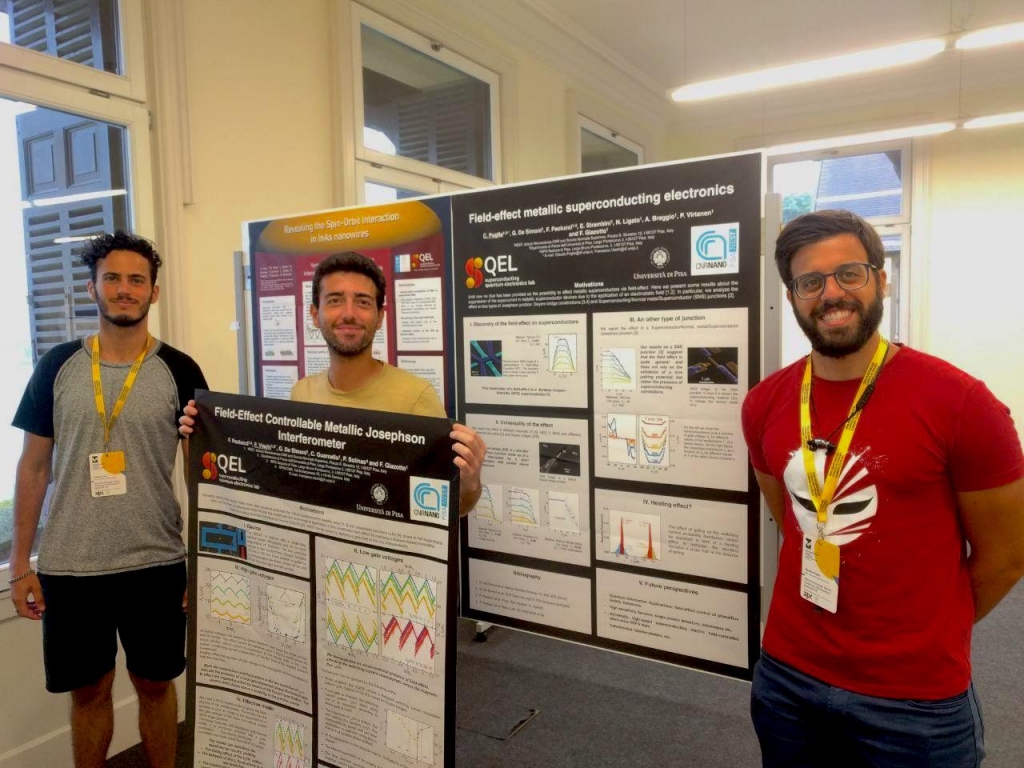
During the school, our students showcased the research carried out at SQEL in three posters: “Field-effect metallic superconducting electronics” (by C. Puglia), “Field-effect controllable metallic Josephson interferometer” (by F. Vischi) and “Revealing the Spin-Orbit Interaction in InAs nanowires” (by A. Iorio).
Group picture at NanoQI’19
A. Iorio, F. Vischi and C. Puglia while presenting their posters at NanoQI’19
We use cookies on our website to give you the most relevant experience by remembering your preferences and repeat visits. By clicking “Accept”, you consent to the use of ALL the cookies.
This website uses cookies to improve your experience while you navigate through the website. Out of these, the cookies that are categorized as necessary are stored on your browser as they are essential for the working of basic functionalities of the website. We also use third-party cookies that help us analyze and understand how you use this website. These cookies will be stored in your browser only with your consent. You also have the option to opt-out of these cookies. But opting out of some of these cookies may affect your browsing experience.
Necessary cookies are absolutely essential for the website to function properly. These cookies ensure basic functionalities and security features of the website, anonymously.
Cookie
Duration
Description
cookielawinfo-checbox-analytics
11 months
This cookie is set by GDPR Cookie Consent plugin. The cookie is used to store the user consent for the cookies in the category "Analytics".
cookielawinfo-checbox-functional
11 months
The cookie is set by GDPR cookie consent to record the user consent for the cookies in the category "Functional".
cookielawinfo-checbox-others
11 months
This cookie is set by GDPR Cookie Consent plugin. The cookie is used to store the user consent for the cookies in the category "Other.
cookielawinfo-checkbox-necessary
11 months
This cookie is set by GDPR Cookie Consent plugin. The cookies is used to store the user consent for the cookies in the category "Necessary".
cookielawinfo-checkbox-performance
11 months
This cookie is set by GDPR Cookie Consent plugin. The cookie is used to store the user consent for the cookies in the category "Performance".
viewed_cookie_policy
11 months
The cookie is set by the GDPR Cookie Consent plugin and is used to store whether or not user has consented to the use of cookies. It does not store any personal data.
Functional cookies help to perform certain functionalities like sharing the content of the website on social media platforms, collect feedbacks, and other third-party features.
Performance cookies are used to understand and analyze the key performance indexes of the website which helps in delivering a better user experience for the visitors.
Analytical cookies are used to understand how visitors interact with the website. These cookies help provide information on metrics the number of visitors, bounce rate, traffic source, etc.
Advertisement cookies are used to provide visitors with relevant ads and marketing campaigns. These cookies track visitors across websites and collect information to provide customized ads.

 The winning micrograph: a superconducting quantum interference proximity transistor with multi tunnel junctions.
  Elia Strambini during his talk at Nanowire Week 2019
  “Field-Effect Controllable Metallic Josephson Interferometer” published on Nano Letters
  ATTRACT is a pioneering initiative bringing together Europe’s research & industrial communities to lead the next generation of detection & imaging technologies.
  SQEL students at NanoQI’19