
Environment-driven quantum effects in superconducting junctions
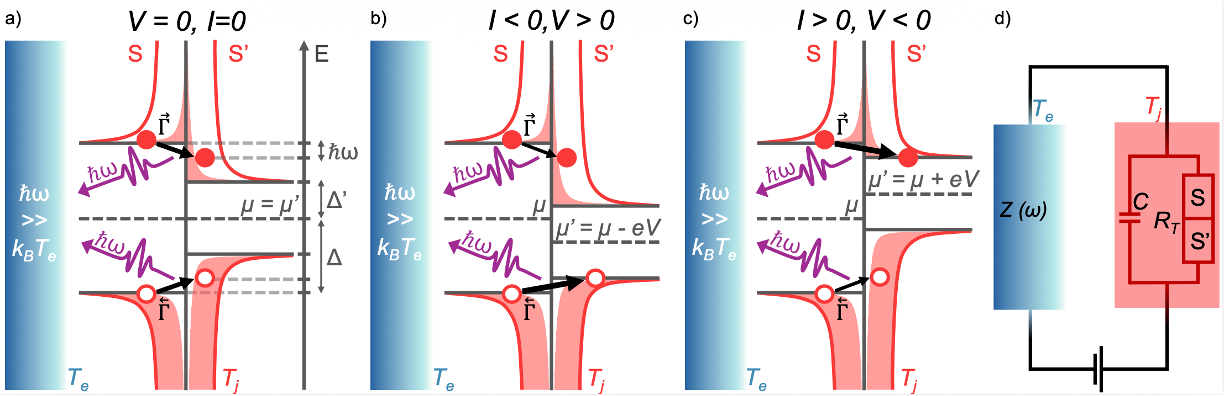
At low temperatures, the electromagnetic environment surrounding a mesoscopic device is not just a source of noise, but an active element that can shape transport in genuinely quantum ways. We study how the coupling between superconducting circuits and their surrounding electromagnetic modes gives rise to phenomena with no classical counterpart, through the interplay of quantum fluctuations, photon-assisted tunnelling, and the dynamical Coulomb blockade. A representative example is quantum bipolar thermoelectricity, where a junction in thermal equilibrium develops a thermoelectric response driven purely by the emission-absorption imbalance of a cold environment. By engineering these environmental modes, this line of research points toward tailored low-temperature thermoelectric devices and toward using superconducting junctions as spectroscopic probes of a quantum bath.

Solid-state Majorana fermions and mesoscopic transport
Superconductors are ideal hosts to investigate macroscopic quantum coherence in mesoscopic transport. They can mediate unique local and non-local transport phenomena of charge, spin or heat. They could also host exotic states, such as Majorana fermions, an unique signature of topological superconductivity. We actively develop novel design and concepts to manipulate those properties. We investigate these phenomenas using a complete set of alternative and complementary techniques both at analytical and numerical level.

Coherent Josephson thermal transport
We concentrate on the coherent control of heat in Josephson junction in novel hybrid device concepts such as heat interferometers, thermal transistors and thermal logic elements. We investigate also how solitonic dynamics can be applied to master coherent caloritronic on a fast timescales. We develop innovative setup for energy harvesting and engine/coolers based on a coherent thermodynamics. We develop those devices with a realistic architecture underlining their possible application in the field of quantum sensing and, in general, for the quantum technologies.

Heat and charge transport in topological nanosystems
Topological materials hybridized with other materials such as superconductors are an unique setups to coherently control transport at nanoscales. We demonstrated also unique capabilities in the possibility of manipulate the entanglement in the solid state. Topological materials are used, in general, to augment the capability Josephson based technologies and apply them in unusual contests.

Superconducting detectors for radiation sensing
Superconducting nanodevices are also widely applied in the field of radiation sensing both for bolometric, calorimetric and single-photon applications. We design novel devices developing also different detection strategies in order to optimize the main figure of merits. In particular we investigate their noise performances and their sensitivity based on a concrete and realistic design. We also support the experimental activities at the level of the planning, analysis and discussion of the measurement results.